Showing posts sorted by relevance for query carver. Sort by date Show all posts

Errand, by Raymond Carver


Raymond Carver at the Wikipedia

Raymond Carver: bibliography

Errand: review

Errand: summary and analysis: enciclopedia

Errand: enotes


Short Cuts (trailer)


Jindabyne (trailer)


Birdman (trailer)


Everything must go (trailer)


A little bit of biography

Raymond (or Ray) Carver was born in a milltown in Oregon (on the West coast), in 1938 and died when he was 50 years old of lung cancer.
His father was a millsaw worker and a heavy drinker, and his mother worked as a waitress and a clerk, so they were a lower class family.
Raymond also worked with his father in the millsaw. He also learned to fish, so fishing is a theme that appears in some of his stories.
At 19 he got married to Maryann Burk, 16 years old. We have to suppose that they married because they had a baby the same year. Then they had another next year.
Both, Raymond and Maryann, had different jobs and they try to go on studying; Maryann finished her studies, but Raymond never finished any of his courses. Besides temporary occupations, he got precarious jobs as a writing teacher or university teacher, but because of his alcoholism he finished working as a janitor in a hospital and writing in his spare time.
At 34 he fell in love with Diane Cecily, editor at university, and he started drinking heavily and abusing his wife.
When he was 38 he began to date Tess Gallagher, a writer who later will become his wife. In this time he had to go to the hospital several times because of liquor intoxication. He realized that he had to stop drinking, and he started his second life thanks to Alcoholics Anonymous (but he never stopped smoking marihuana and even tried cocaine).
At 44, he got divorced (he was already living with Tess).
Six weeks before dying at 50, he got married to Tess.
He published his first short story when he was 23 and was studying at Chico Public University. It was called The Furious Seasons and bore a strong influence of William Faulkner.
His first short story collection Will You Please Be Quiet, Please? was published when he was 38. But although it was shortlisted for the National Book Award, he didn’t sell many copies.
He had more collections of short stories, and the most famous are What We Talk When We Talk About Love and Cathedral.
When we talk about Carver we talk about minimalism and dirty realism. Minimalism means avoiding all rhetoric, and that if you can say something in ten words, please, don’t use twenty. And dirty realism implies that in your stories you are going to use characters that belong to the lower classes of the society, that your heroes are going to be anti-heroes, e.g., isolated marginalized people, people with alcoholic problems or difficult relationships or broken families. So we have to suppose they are sad stories.
Everyone can feel the influence of Hemingway minimalism in his work, but he said his main influence was D. H. Lawrence.
It’s an irony, but the last story he wrote, before dying, is Errand, where he narrates an anecdote of Chekhov, another famous short story writer, just before his own death.

Errand

In this story, very different from his other stories because it’s almost “classical”, Carver writes about the last days of the life of Chekhov, a Russian writer revered by most short story writers. Chekhov was having dinner with Suvorin, a publisher, in Moscow, when he started bleeding from his mouth. The Russian author knows that his life is in danger and travels first to Berlin with his wife Olga Knipper, where he sees a doctor who doesn’t help him, and then to Badenweiler, a spa resort where he says he expects to get some recovery (although he doesn’t really believe it). He and his wife are staying in a hotel, and the doctor who treats him, Dr Schwörer, realizes that there’s no hope and orders champagne as the last honour to the famous writer. The author drinks and dies, and then there is a change in the way of telling the story, because we see the situation through the eyes of his widow Olga. Then, after a wake until morning, she asks a waiter who had come into the room to bring a vase of flowers to go and fetch the mortician. The story has a special ending, but I’m not going to be a spoiler revealing it.

QUESTIONS

Talk about the characters according what it is said about them in the story. But what do you know about them as historical people? Did they know Chekhov or his writings?
Anton Pavlovich Chekhov
Suvorin
Maria Chekhov
Lev Nikolayevich Tolstoy
Olga Knipper
Dr Karl Ewald
Dr Schwöhrer (and his presciptions)
The waiter (the young blond man)
What happened at the restaurant in Moscow?
What were the characters’ feelings about the TB?
Personal question: Do you have an opinion or a belief about the immortality of the soul?
What do you know about TB?
Where is Badenweiler?
Explain the courtship between Olga and Anton.
What can you say about The seagull and The Cherry Orchard?
Why did Chekhov mention the Japanese?
Summarize in one sentence Chekhov’s death.
What do you think is the meaning of the “large moth”?
What is the meaning of “history” in the sentence “Dr Schwöhrer picked up his bag and left the room and, for that matter, history.”
What happened with the bottle’s cork?
Describe the scene between Olga and the young man at Anton and Olga’s room.
What is the meaning of the title Errand?
In the last paragraphs, there is a change in the verbal tense: the past tense has changed into “would”? Why?
What do you think is the meaning of picking up the cork in the last sentence of the story?

VOCABULARY

private, take in (took in), stanch, jest, sleet, well-wisher, out-line, junk, bearskin, numbered, reckless, on the mend, complexion, Moët, grapple, mortician


Collector, by Raymond Carver


Summary and analysis

Review

Deep analysis

BIOGRAPHY: click here

SUMMARY

Mr Slater is at home alone. Outside, it’s raining. He is out of work and has been waiting for the post man for some time. He’s expecting an important letter.

Then somebody knocks at the door, but it isn’t the postman, because he knows his tread. Mr Slater doesn’t move at the knocking, but the man outside insists. It turns out to be a salesman, Mr Audrey Bell. He was looking for Mrs Slater, because he says she had won a prize. But there is no Mrs Slater in the house. Later we learn that the “prize” is a free vacuuming of the house.

Mr Bell comes into the house a little bit as if he was invading it: Mr Slater doesn’t really invite him to come in, but, although he puts up some resistance at the beginning, he soon seems a bit indifferent to the intrusion. The salesman takes off his coat and his galoshes and starts to assemble a contraption that turns out to be a vacuum cleaner. He behaves as if he were at home, and even asks for an aspirin because he says he has a headache.

Once the machine is ready, he goes to the next room and starts to clean a mattress. It is an easy task because the blankets are on the floor, as if nobody wanted to sleep on it anymore.

After that, Mr Bell goes to the sitting room and asks for some dirt or a full ashtray. Mr Slater gives him a full ashtray and Mr Bell empties its contents onto the carpet there; he wants to demonstrate how well the machine works. All the while, the owner of the house has been watching the salesman’s operations without complaining, but also keeping telling him he isn’t going to buy anything.

While the salesman is doing his demonstration, the letter Mr Slater was waiting for arrives. The postman has slid it inside through the mail slot. But neither Mr Slater nor the Mr Bell go to pick it up.

When the salesman has finished his work, picks the letter up, reads the recipient (that was Mr Slater), folds the letter, puts it in his pocket, puts on his coat and galoshes, and goes away. Never Mr Slater tries to get the letter; he only makes sure he was indeed the addressee. He doesn’t buy the vacuum cleaner.


QUESTIONS


-I suppose you had paid attention that in the story the dialogues are not marked (with quotations marks, for example). Why do you think the author uses this stylistic device?

-In your view, why does the salesman mention some important writers? What do you know about Auden, Rilke, Voltaire and Madame Châtelet?

-Mr Bell pulled his lips? What can be the meaning of this gesture? Do you remember some other curious gestures or grimaces?

-In your opinion, what is the relation between the title and the story?

-The story is very simple, but it has to have a deeper meaning: for you, what is its true meaning?


VOCABULARY


notices, railhead, corns, matted, churchly, scoop, tugged


October and June, by O. Henry


SUMMARY, by J. Guiteras

The captain, who had kept his uniform worn out by time and service in a closet, was enchanted by the sweet and smiling lips of a woman.

He received a letter from this woman telling him that she would not marry him because of the age difference between them.

The captain, who was rich and handsome, did not resign himself to this refusal and took a train to see her so that she could reconsider.

She stood firm in her decision, arguing that within a few years one of them would want to be quiet at home and the other would be crazy about going out to parties.

The captain was sad because he had lost the battle and returned home.

The next day he reflected and came to the conclusion that Theo, the woman, was right, since one of them was 28 years old and the other was only 19 years old.


Reflection: I feel sorry for them because a younger person can always learn a lot from another one who is older and with experience and has a lot to teach to a youngster.


QUESTIONS

-Why was the age gap very important in the past, and now isn’t so?

-Do you think we’ll be able to overcome all the clichés? Are prejudices good or bad for daily life?

-In your opinion, what is the relation of the title with the story?


VOCABULARY

gloomily, rugged, squared, ‘Pon

BIOGRAPHY, by Begoña Devis

William Sydney Porter was born in North Carolina in 1862 and died in New York in 1910. He was a great writer known as O. Henry after a cat he lived with for a time. He is considered one of the masters of the short story. His admirable treatment of surprise narrative endings popularized in English the expression "an O. Henry ending".
He had an eventful life. His mother died when he was three, and he and his father moved to his paternal grandmother's house. As a child he was a good student, and a great reader. He graduated from his aunt's school, who continued teaching him until he was 15. He then began working in his uncle's pharmacy and finally graduated as a pharmacist.
In 1882 he went to Texas, hoping that a change of scenery would improve his persistent cough. There he worked there as a ranch hand, as a cook and as a nanny. When his health improved, he went to Austin, where he worked as a pharmacist and where he began writing short stories. He was popular in the social life in Austin for his storytelling and musical talent. At this time, his problems with alcohol abuse began. In 1887, he eloped with the young Athol Estes, daughter of a wealthy family. In 1888 they have a child, who died. In 1889, a new daughter, Margaret, was born.
In 1894, Porter founded a humorous weekly magazine called The Rolling Stone.  Then that magazine collapsed, and he moved to Houston, where he was a journalist at the Houston Post.
The most transcendental event occurred in 1895, when he was accused by the First National Bank of appropriating money that he had under his responsibility. On the eve of the trial he sailed for Honduras, where he lived for seven months, and where he wrote several stories, many of which appear in the book Cabbages and Kings, in which he coined the term «banana republic», phrase subsequently used to describe a small, unstable tropical nation in Latin America.
In 1897 he returned to Austin when he knew that his wife was dying, and after a few months he was arrested and convicted, spending three years in the Columbus (Ohio) prison. There he continued writing short stories to support his daughter. When he was released from prison, he changed his name to O. Henry and moved to New York, where he lived until his death.
In New York, the city the writer loved and the setting for many of his stories, O. Henry gained public recognition, but he had a deep problem with his alcoholism. Indeed, there is an anecdote that his most famous story, "The Gift of the Magi", was written under the pressure of a deadline, in just three hours and accompanied by a whole bottle of whiskey.
From December 1903 to January 1906, he wrote a story a week for the New York World, his most prolific period. He remarried in 1907 to his childhood sweetheart, Sarah Lindsey Colem, who left him in 1909.
O. Henry died on June 5, 1910 of cirrhosis of the liver. His funeral was held in New York and he was buried in Asheville, North Carolina. His daughter, Margaret Worth Porter, died in 1927 and was buried next to her father.
In the United States, the O. Henry Award for short stories, one of the most important in the world, was created in his memory. Among other writers, it has been awarded to William Faulkner, Dorothy Parker, Flannery O'Connor, John Updike, Truman Capote, Raymond Carver, Saul Bellow and Woody Allen.


Janus, by Ann Beattie

Audiobook

Review

Summary and analysis

Written by Pere Vila

CONTEXT

Ann Beattie was born in 1947 in Washington D.C. She is an American novelist and short story writer. She has received an award for Excellence from the American Academy and Institute of Arts and Letters, and the PEN/Malamud Award for Excellence in the short story form.

Beattie reached adulthood during the transformative 1960s, a period marked by the Vietnam War, the rise of drug culture, and the Civil Rights Movement in the southern United States. Although Beattie’s stories aren’t explicitly set in this decade, her characters are undeniably children of the era, shaped by its cultural upheavals. The legacy of the 1960s is evident in their struggles with identity and purpose in a rapidly changing world.

By the 1980s, many of Beattie’s contemporaries, often identified as baby boomers, had established themselves in stable careers and family lives. Despite their material comfort, they suffer emotional and moral disconnection in a world that has yet been rather generous to them in material ways. They now live in suburban and urban settings, and are engaged in professions like finance, law and writing, having transitioned from the radical thinkers of their youth to members of the establishment they once opposed.

Amidst the social evolution of the 1970s and 1980s, minimalism emerged as a significant artistic movement. In art, minimalism utilized small and simple spaces to focus on the subtleties of space and form. In literature, minimalism took on a similar approach, emphasizing what was left unsaid as much as what was articulated. Minimalist writers like Ann Beattie, Bobbie Ann Mason and Raymond Carver cut down stories to their essential elements, concentrating on the minutiae of daily life over grandiose moral issues, reinforcing the notion that minimalism can convey profound truths through simplicity.


JANUS


Beattie’s story Janus, first published in The New Yorker in 1985 and later included in the collection Where You’ll Find Me, exemplifies her exploration of contemporary life’s vacuity. Janus reflects the desires and disillusionments of the middle and upper-middle-classes, the social groups that Beattie is often considered representing. In this short story, the author expertly combines narrative technique and symbolism to explore themes of longing, memory, and the subtle, pervasive influence that objects can exert on our lives.

Janus, the two-headed ancient Roman divinity, was considered to be the god of doorways, portals, gates, passageways, bridges, and entrances and exits of temples. The people of ancient Rome believed that Janus, with his two heads, witnessed the comings and the goings of people, the past, and the future; but, in modern times, Janus is associated with hypocrisy and being “two-faced”. Both these different connotations of the word “Janus” are present in the Ann Beattie’s short story of the same name.

Janus is the story of a married real estate agent named Andrea who possesses a decorative bowl to which she is greatly attached. Andrea seems to have an obsession with the bowl. She leaves it in the houses that she is engaged to sell and believes that the bowl brings her luck and is responsible for the sale of the houses. She warns her husband against leaving his keys in the bowl and is greatly disturbed by the idea that she might lose it. Andrea believes that she has a ‘relationship’ with the bowl. It is revealed that the bowl is a gift from a former lover. The lover asked her to leave her husband and be only his, but she would not do so. He termed her “two faced”. Andrea wanted a future with her lover, but was unwilling to give up her husband, despite being unsatisfied with him.

Beattie uses the bowl to draw the readers’ attention to deeper themes within the narrative. This object is meticulously placed in various settings, subtly highlighting its significance. The bowl could be interpreted as a reflection of Andrea’s own life: smooth and seemingly perfect, yet fundamentally hollow. It may also signify the materialistic and emotionally barren world experienced by Andrea’s generation as described in the phrase “the world cut in half, deep and smoothly empty”. Furthermore, the bowl is a poignant reminder of Andrea’s former lover, who remains a distant memory, a “vanishing point on the horizon”. This object becomes the remaining relic of her lost relationship, symbolizing her attachment to the past.

The concave shape of the bowl is symbolic of the emptiness and lack of meaning in Andrea’s and her husband’s life. Though never explicitly stated, the absence of children becomes a silent witness to the lack of vitality in her relationship. Andrea consciously chooses not to have children, what is expressed in her obsessive attention and affection for an inanimate object.

As suggested by the tittle, Janus is a deeply ambiguous work of short fiction, open to multiple interpretations, but on the whole, it is a call to abandon banal life and embrace passion.


QUESTIONS

-What do you know about Bonnard and Biedermeier?

-Can you describe an object of yours and tell us its sentimental worth?

-The narrator wants her bowl always empty. What can be the meaning of this mania?

-"He had no more interest in the bowl than she had in his new Leica." Does that mean there were no love between them? What other hints can tell us that a couple are not anymore in love?

-What is a secret? Can a secret be constant / forever?

-"With a lover, there is no exact scenario of how matters would come to close." What things in our lives have a predictable end and what things don't?

-What kind of professions demand to be double-faced? To be double faced is the same as hypocrisy?

-What can be the meaning of the last sentence, "the eye moved toward one small flash of blue, a vanishing point on the horizon"?


VOCABULARY

mutt, batting, still life, flecks, lean, bids, dovetailed


Telemachus, friend, by O. Henry


BIOGRAPHY, by Begoña Devis
 
William Sydney Porter was born in North Carolina in 1862 and died in New York in 1910. He was a great writer known as O. Henry after a cat he lived with for a time. He is considered one of the masters of the short story. His admirable treatment of surprise narrative endings popularized in English the expression "an O. Henry ending".
He had an eventful life. His mother died when he was three, and he and his father moved to his paternal grandmother's house. As a child he was a good student, and a great reader. He graduated from his aunt's school, who continued teaching him until he was 15. He then began working in his uncle's pharmacy and finally graduated as a pharmacist.
In 1882 he went to Texas, hoping that a change of scenery would improve his persistent cough. There he worked there as a ranch hand, as a cook and as a nanny. When his health improved, he went to Austin, where he worked as a pharmacist and where he began writing short stories. He was popular in the social life in Austin for his storytelling and musical talent. At this time, his problems with alcohol abuse began. In 1887, he eloped with the young Athol Estes, daughter of a wealthy family. In 1888 they have a child, who died. In 1889, a new daughter, Margaret, was born.
In 1894, Porter founded a humorous weekly magazine called The Rolling Stone.  Then that magazine collapsed, and he moved to Houston, where he was a journalist at the Houston Post.
The most transcendental event occurred in 1895, when he was accused by the First National Bank of appropriating money that he had under his responsibility. On the eve of the trial he sailed for Honduras, where he lived for seven months, and where he wrote several stories, many of which appear in the book Cabbages and Kings, in which he coined the term «banana republic», phrase subsequently used to describe a small, unstable tropical nation in Latin America.
In 1897 he returned to Austin when he knew that his wife was dying, and after a few months he was arrested and convicted, spending three years in the Columbus (Ohio) prison. There he continued writing short stories to support his daughter. When he was released from prison, he changed his name to O. Henry and moved to New York, where he lived until his death.
In New York, the city the writer loved and the setting for many of his stories, O. Henry gained public recognition, but he had a deep problem with his alcoholism. Indeed, there is an anecdote that his most famous story, "The Gift of the Magi", was written under the pressure of a deadline, in just three hours and accompanied by a whole bottle of whiskey.
From December 1903 to January 1906, he wrote a story a week for the New York World, his most prolific period. He remarried in 1907 to his childhood sweetheart, Sarah Lindsey Colem, who left him in 1909.
O. Henry died on June 5, 1910 of cirrhosis of the liver. His funeral was held in New York and he was buried in Asheville, North Carolina. His daughter, Margaret Worth Porter, died in 1927 and was buried next to her father.
In the United States, the O. Henry Award for short stories, one of the most important in the world, was created in his memory. Among other writers, it has been awarded to William Faulkner, Dorothy Parker, Flannery O'Connor, John Updike, Truman Capote, Raymond Carver, Saul Bellow and Woody Allen.
 

TELEMACHUS, FRIEND
 
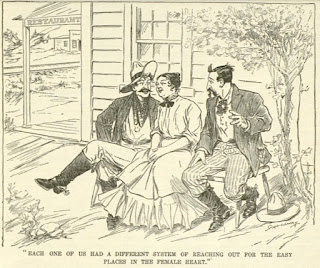
The story begins when a hunter asks a man named Telemachus about his damaged ear, because it seems mutilated by a beast. Telemachus tells him that this ear is a mark of a really deep friendship between he and a man named Paisley, a friendship as strong as the one Damon and Pythias had.
He explained him that Telemachus and his friend spent seven years together, doing several jobs and living different experiences. Once they were in the town Los Piños and here they met a widow named Jessup, and both friends were attracted to her and each one wanted to marry her. But they didn’t want to lose their friendship and decided that if one of them reached her first, he would wait to the other to come before making advances, and would not do anything in secret. They decided to stay friends whoever won.
This situation ended up tiring the widow, who was most interested in Hinks and saw that he didn’t make any advance without being in the presence of his friend.
In spite of this, she still decided in the favour of Hicks and decided to marry him. At the wedding ceremony, Hicks asked the priest to wait until Paisley came. He finally came looking in his best, just in case the priest confuses them and marry Jessup to him instead Telemachus.
At night, after the wedding ceremony, Jessup waited in the room while Hicks sat outside. She asked him to come inside. He said her that he was waiting for his friend to come. After that Hicks felt as if somebody had shot his ear. In fact, it was a blow by Mrs. Hicks’s broom handle. This is the mark of his deep and truly friendship.


Audiobook

QUESTIONS

Describe the two friends.
What kind of friendship do they have?

Which is the first threat to this friendship?

What do you know about Damon and Phytias?

What is the meaning of this phrase: "anchovy to forget his vows"?

Describe Mrs Jessup.

What did Telemachus mean with "fidus Diogenes"?

What was the problem with Spring Valley / Big Spring Valley?

What is "to make a movement that leads up the widow to change her name to Hicks"?

Try to explain this image: "The smiles of a woman is the whirpool of Squills and Chalybeates into which the vortex of the good ship  Friendship is often drawn and dismembered"?

What is the "hot biscuit of Mrs Jessup"?

What are the "medicinal whirpools"?

What is a jew's harp?

What was the woman reaction to their idea of shared courtship?

Describe their different kind of courtshiping.

-Paisley

-Telemachus

Give some information about

-Rider Haggard

-Lew Dockstader

-Parkhurst

What does this mean: "when she can be referred as 'née Jones'"?

What happened exactly in the paragraph "One night... but I didn't"? (page 171, lines 25-29)

Who marries Mrs Jessup at last?

Why did his friend come to the wedding?
What happened to Lem's ear and why?

VOCABULARY

intent, dipper, graft, entitlement, churn, surcease, habiliment, pry, anchovy, in hoc signo, dogwood, chip, accrue, japonica, hiatus, railroad tie, Squills and Chalybeates, opodeldoc, hoss, synonymously, gallivantery, dough, crock, cinctured, drought, pipeful, hike yourself down the gulch, disresume, Lem, nix cum rous, Hubbard squash, wear the willow, cinch, cuff, bowery, durn,